

Entering the 2026 general election cycle, the National Unity Platform (NUP), led by two-time presidential candidate Robert Kyagulanyi Ssentamu alias Bobi Wine, presented a manifesto that not only commits to resetting Uganda’s political and economic landscape but also prioritises climate resilience and sustainable natural resource governance as critical building blocks for national renewal.
The NUP acknowledges the profound risk that climate disruption poses, recognising its role in driving poverty, deepening insecurity, and undermining the rural economy that supports over 70% of Ugandans.
Unlike earlier opposition and ruling party manifestos, the NUP’s platform integrates environmental sustainability as both an economic and social justice imperative. The manifesto makes a call for an interconnected approach, encompassing the restoration of degraded ecosystems, mainstreaming climate action within the development agenda, ensuring environmental rights, and promoting inclusive, sustainable growth.
The manifesto’s climate rationale is also a direct critique of decades of “business as usual”, where rapid deforestation, wetland loss, urban pollution, and weak enforcement have undermined Uganda’s natural capital. NUP pledges a break from these patterns through people-centred, transparent reform grounded in international commitments, such as the Paris Agreement, Uganda’s own Vision 2040, the National Development Plans (NDP III/IV), and the new National Climate Change Act and National Climate Finance Strategy.
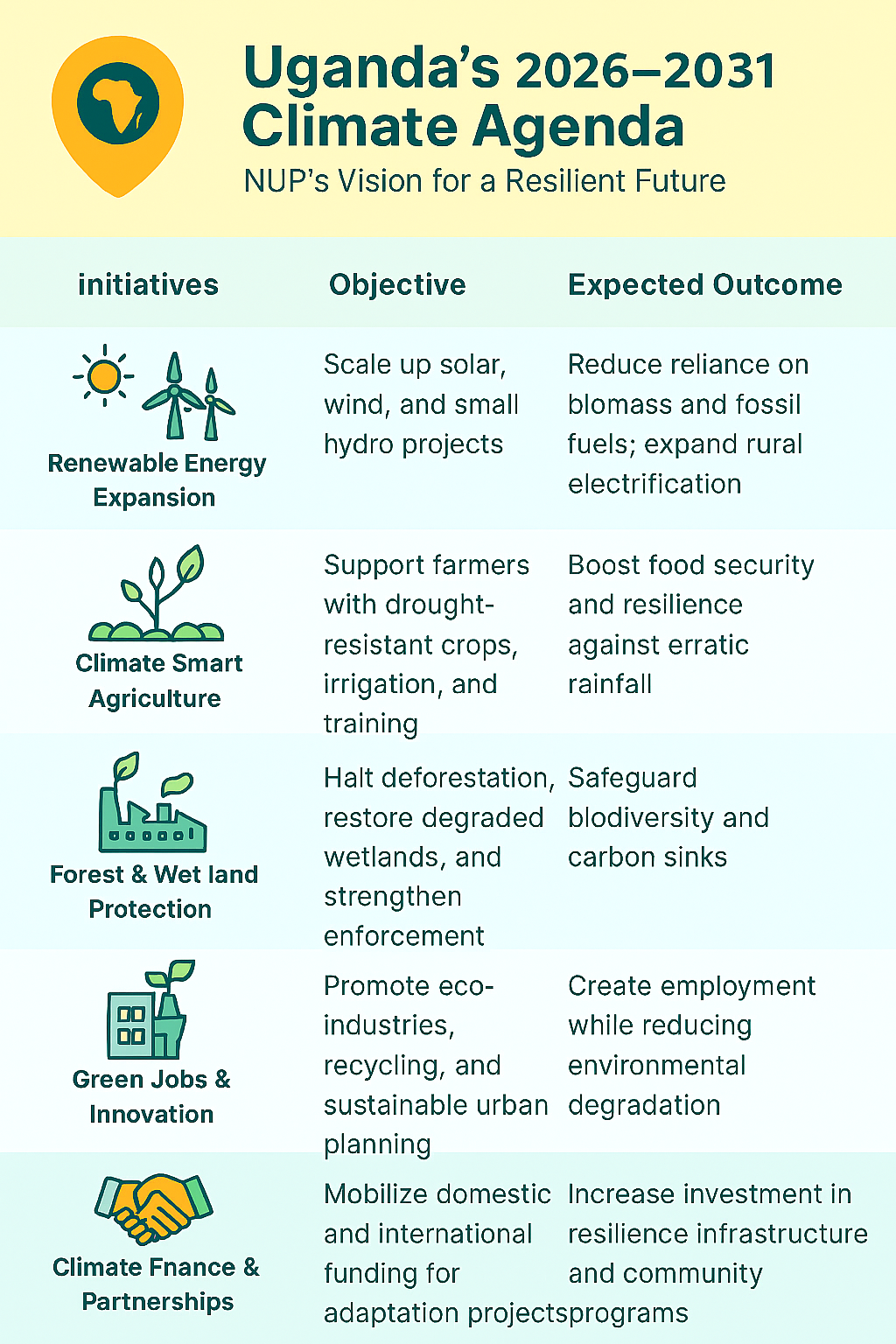
Here are some of NUP's manifesto's salient climate action plans:
Greenhouse gas reduction
The NUP pledges to realise Uganda’s Paris Agreement Nationally Determined Contribution (NDC): a 24.7% GHG reduction from business-as-usual by 2030. The approach is sectoral, emphasising energy, agriculture, forestry, waste, and transport. By formalising mitigation across ministries, local governments, and the private sector, Uganda will shift decisively toward low-carbon development pathways, while unlocking access to green global climate finance and carbon markets.
The party plans to achieve this target through incorporating mitigation in all relevant economic sectors (energy, transport, industry, waste, developing emission inventories and reporting according to the Climate Change Act (2021) and new regulations, strengthening systems for verification and transparency, including independent, registered MRV (Measurement, Reporting, and Verification) agents, and adopting penalties for non-compliance with sectoral GHG targets.
Green/Renewable and Cooking Energy
Universal access to affordable, clean energy is positioned as a foundation for green economic transformation. NUP commits to dramatically expanding renewable energy's share, especially solar, hydro, biomass, and wind, while phasing out new fossil fuel investment. A sectoral energy transition will reduce household air pollution, cut GHG emissions, generate green jobs, and position Uganda for regional clean energy export. Enhanced access especially benefits women and marginalised groups, while attracting new forms of climate finance.
"Solar energy offers a clear, decentralised solution to Uganda’s rural electrification challenge. Yet, despite strong potential, the sector has remained underfunded and marginalised in national planning," NUP's 'A New Uganda' Manifesto.
Some of the party's immediate actions will include investing in the extension and upgrading of electricity transmission infrastructure, especially to rural and peri-urban areas. Priority given to clean mini-grids and off-grid solar systems, promoting local manufacturing, tax incentives, and public–private partnerships for solar panels and wind turbines, accelerating improved cookstove programmes, biogas expansion, and modernising charcoal value chains to reduce health and environmental impacts.
Additionally, NUP will prioritise enforcement of relevant acts (Electricity Act, Renewable Energy Policy), and support the National Renewable Energy Platform’s strategic plan for 2023–2028 and partnerships for green investment.
Read our analysis of the National Resistance Manifesto here: https://lastdropafrica.org/articles/articles/climate-action-nrm-to-focus-on-urban-greening-clean-energy-and-blue-economy-initiatives-in-manifesto-2
Climate Smart Agriculture
Recognising the vulnerability of Uganda’s agrarian economy to climate shocks, the NUP advances a robust CSA agenda focused on boosting resilience, food security, productivity, and farmer incomes. This aspect hinges on expanding the Uganda Climate Smart Agriculture Transformation Project (UCSATP), supporting development of heat/drought-tolerant crop varieties, livestock breeds, and adaptive fisheries models, including competitive research grants of up to $250,000 per value-chain project.
Additionally, NUP envisions rolling out e-voucher systems for climate-resilient seeds, fertilisers, and agri-inputs, linked to certified dealers, to cut corruption and increase farmer access, increase investment in irrigation, post-harvest and storage infrastructure, and water management for agriculture, targeting both rain-fed and irrigated zones.
The party promises to prioritise and incentivise women, youth, refugees, and marginalised farming communities with access to grants, training, and cooperatives to bolster market access, agro-processing, value addition, insurance, and climate risk finance mechanisms.
Through this approach, NUP hopes to uplift more than 3.5 million smallholder farmers from poverty, curb crop and livestock losses, and reduce agricultural waste emissions.
Budgeting
NUP proposes integrating climate risk forecasting into Uganda’s annual and medium-term budget planning. This would institutionalise “climate tagging”, tracking every shilling of climate-related expenditure for transparency and measurable impact. This approach mirrors global best practices seen in Kenya and Indonesia’s fiscal reform programs.
The budget aside, NUP plans to create a dedicated National Adaptation Fund, ring-fenced for community-level resilience projects. Priority areas include climate-smart agriculture, sustainable water access, and public health resilience, areas critical for a nation where 80% of people lack access to safe drinking water and 85% rely on biomass for energy.
Biodiversity restoration
The manifesto commits to restoring three million hectares of degraded ecosystems such as forests, wetlands, and rangelands by 2030. It also advocates integrating ecosystem valuation into infrastructure and planning, ensuring natural capital is treated as a core national asset.
The party further hinges on building development partners and private investors to unlock new streams of climate finance, ensuring funding for Uganda’s adaptation and mitigation priorities and investing in predictive early-warning systems and community-based predictive strategies to safeguard lives, livelihoods, and public infrastructure.
Summarily, despite this ambitious framing, the plan’s operational depth remains thin. There are no clear emission-reduction targets or a renewable energy transition strategy, and its focus on fiscal instruments is not supported by a plan to strengthen weak environmental institutions like NEMA. Likewise, the manifesto underplays the urgency of integrating clean energy systems, sustainable urban planning, and modern monitoring technologies that would translate its vision into measurable progress.
Read the party's full manifesto here: https://nupuganda.org/wp-content/uploads/2025/09/NUP-Manifesto.pdf