In a nation whose economy, food security, and culture are so deeply tied to land and water, climate change and natural resource management have become political battlegrounds.
The manifesto highlights forests, wetlands, lakes, and rivers as the “invaluable heritage” upon which the country’s prosperity depends. The NRM, which has governed Uganda for nearly four decades, frames itself as a steward of these resources, pointing to past achievements and laying out a roadmap for the next five years.
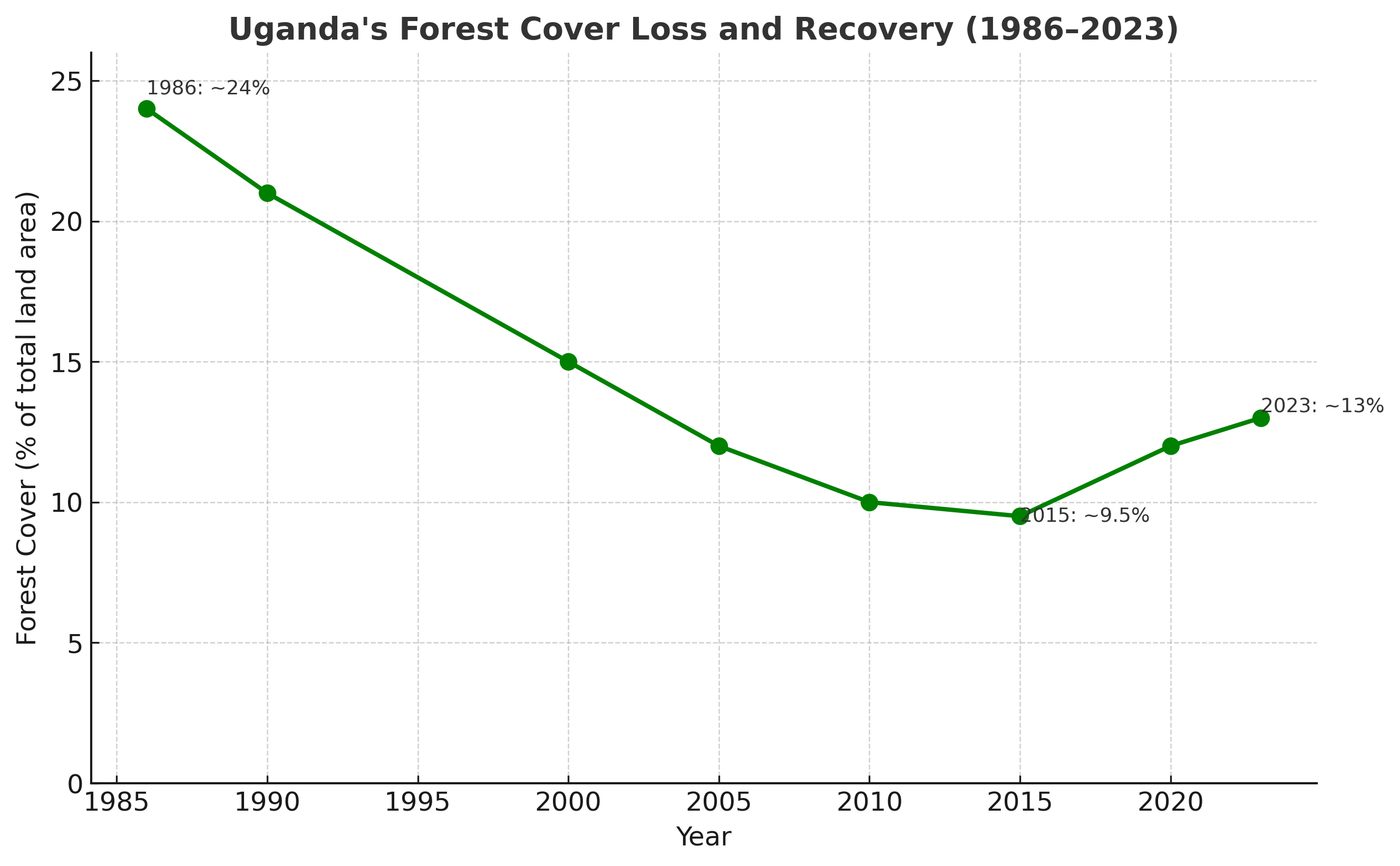
The party paints a positive picture of progress over the last decade. Uganda’s forest cover, which plummeted in the 2000s due to deforestation and charcoal burning, has reportedly climbed back to 13 per cent in 2023, up from 9.5 per cent in 2015. This recovery, according to the manifesto, has been driven by reforestation and strict crackdowns on illegal logging and encroachment.
Wetlands, Uganda’s most threatened ecosystems, are also given pride of place. The NRM claims that more than 1,280 km² of wetlands have been restored, 3,200 km demarcated, and over 8,600 sites gazetted to protect them from agricultural encroachment.
We have also protected our wetlands. Uganda has a wetland cover of 10–13%
of the land area, and these perform functions that are difficult and costly to
replace if lost. The total length of wetlands in Uganda is 144,319.06 km.
Perhaps most strikingly, the government claims to have cancelled 330 illegal land titles in wetlands, a bold step in a country where land ownership often intersects with political patronage. Researchers note that while gains in forest cover are encouraging, enforcement of environmental law is uneven and often undermined by corruption or political interference.
Wetland protection, too, has been patchy, with many restored sites under pressure from expanding rice farming, brick-making, and urban sprawl.
NRM's big climate action bets for 2026-2031
The manifesto outlines a nine-point plan. At its core, it seeks to balance environmental protection with economic growth; a delicate act for a country with one of the world’s fastest-growing populations. Below is a breakdown of the ruling party's big bets.
Regulation and Enforcement
The government promises a crackdown on encroachment, illegal logging, and pollution, with wetlands and water bodies given special attention. While this signals intent, Uganda’s long history of weak enforcement raises questions about political will and capacity by enforcement bodies such as the National Environment Management Authority (NEMA).
The NRM is credited with the establishment of the Environmental Police for the detection of environmental crimes and enforcement of the law. However, neither NEMA nor the NRM can shake off the accusation of selective application of the law, with the poor bearing the most brunt of evictions while the rich continue to raise buildings in protected areas, unscathed.
Urban Forestry and Greening
Arguably, one of the most urgent and novel inclusions in the NRM Manifesto is the greening of cities and urban areas across the country. Starting with the Capital, Kampala, the loss of green zones to high-rise buildings such as arcades, malls, offices and apartments has significantly contributed to the poor air quality in the city. Kampala is now a concrete jungle with only three basins of green spaces left; two of which are affiliated to the Buganda Kingdom, and the other right next to Uganda Railways.
I was looking through a map of Kampala city and found that only two small islands of green spaces remain in Kampala, surrounded by concrete.
Those two islands are the Kabaka's palace and the Kasubi tombs, both owned by @BugandaKingdom_
Thank you @cpmayiga and the whole Kingdom… pic.twitter.com/dvAf7HJFuT
— Daniel Lutaaya (@DanielLutaaya) September 18, 2025 >
In 2020, the NRM government, through Parliament, approved the creation of 15 new cities, all of which have a dearth of green spaces for public utility. With Uganda’s urban population set to double by 2050, this could prove critical in curbing heat islands, reducing air pollution, and improving quality of life.
Commercial Forestry and Value Addition
The NRM proposes supporting commercial forestry, promoting private investment, and building a wood processing hub at Nyabyeya Forestry College to train a new generation of forestry professionals. By shifting focus from raw timber to processed products, Uganda could create jobs while reducing waste. However, this could exacerbate the reduction of the country's forest cover and reverse the reforestation gains recorded in the last five years, if not well implemented.
From 1986 to 2023, Uganda has lost over 40% of its total forest cover in absolute terms, with partial recovery in the past five years according to World Bank and Food and Agriculture Organisation (FAO) statistics (see infographic below).
Clean Energy Transition
The NRM will further promote the use of alternative sources of energy for cooking, away from charcoal and firewood, including supporting livestock farmers to invest in biodigesters for biogas production. While important, this focus on biogas risks being too narrow; Uganda’s energy transition will also require scaled-up investment in solar and thermal energy to supplement the hydro-electricity.
While Uganda is naturally endowed with bountiful sources of renewable energy, such as flowing rivers, the sun that shines throughout the year, wind, geo-thermal energy from the earth's heat and biomass (bargasse) from plant and animal waste, almost half of the country's population (46.6%) is not connected to the electricy according to the 2024 National Population and Housing Census. Additionally, more than 75% of the households in Uganda still rely on firewood and charcoal for cooking.
The other NRM magic bullets are all linked to the blue economy. These include promoting and emphasising alternative livelihoods to people who currently depend on wetlands for survival. Fish farming, small-scale tourism, and agroforestry are all floated as solutions to reduce destructive practices like rice farming in fragile areas. Eco-tourism, they argue, can "create jobs and foster prosperity while maintaining the ecological health of our lakes and rivers."
So, what could possibly go wrong?
For starters, these proposals are yet another example of just how much of small thinkers our leaders are. While countries like Ethiopia are going all-out on energy generation with their GERD megadam generating 5,000 megawatts, and reforestation plans to plant 50 billion trees by 2026. The NRM's campaign mantra of "protecting the gains" falls short of going after a bigger legacy for which they could be celebrated for years to come.
Beyond urban greening, the manifesto lacks clear strategies for managing flooding, heat stress, and waste in rapidly expanding cities. As Kampala’s streets flood each rainy season, residents will expect more than greenery. Investments in drainage systems, waste management, and sustainable public transport, such as railway and e-mobility services, are critical to protect cities from climate shocks.
Secondly, there is no clear financing strategy. Uganda will need significant climate finance to scale up restoration, renewable energy, and urban adaptation. The manifesto is silent on how it plans to meet the budgetary shortfalls and mobilise international capital needed to achieve its climate targets. Without funding and political will, these policies will evaporate faster than a fart in the wind.